示例
下面的大多数示例都假定Snakemake在特定项目的根目录中执行。下面的Snakefiles中的路径是相对于该目录的。我们遵循惯例为不同的中间结果使用不同的子目录,例如, ``mapped/``文件夹存放比对序列reads的 ``.bam``文件。
Cufflinks
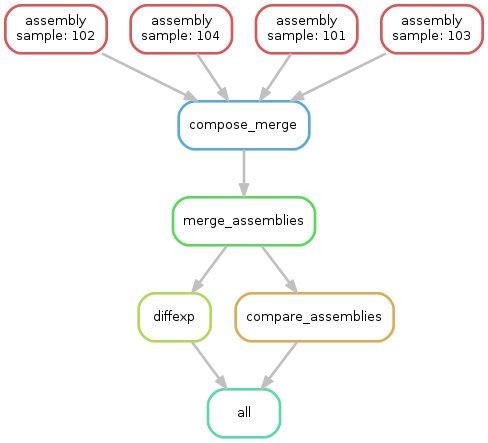
Cufflinks 是用于RNA-seq数据转录本组装,计算丰度,差异表达分析的工具。本示例说明如何使用Snakemake创建典型的Cufflinks工作流。 假定将给定四个样本101-104的比对RNA-Seq数据bam文件。
- 对于每个样本,转录本使用
cufflinks进行拼接组装(规则assembly) cuffmergemerge转录本gtf(规则merge_assemblies)- 和hg19注释文件进行比较(规则
compare_assemblies) - 最后,根据找到的转录本计算差异表达(规则
diffexp)
# path to track and reference
TRACK   = 'hg19.gtf'
REF     = 'hg19.fa'


# sample names and classes
CLASS1  = '101 102'.split()
CLASS2  = '103 104'.split()
SAMPLES = CLASS1 + CLASS2


# path to bam files
CLASS1_BAM = expand('mapped/{sample}.bam', sample=CLASS1)
CLASS2_BAM = expand('mapped/{sample}.bam', sample=CLASS2)


rule all:
    input:
        'diffexp/isoform_exp.diff',
        'assembly/comparison'


rule assembly:
    input:
        'mapped/{sample}.bam'
    output:
        'assembly/{sample}/transcripts.gtf',
        dir='assembly/{sample}'
    threads: 4
    shell:
        'cufflinks --num-threads {threads} -o {output.dir} '
        '--frag-bias-correct {REF} {input}'


rule compose_merge:
    input:
        expand('assembly/{sample}/transcripts.gtf', sample=SAMPLES)
    output:
        txt='assembly/assemblies.txt'
    run:
        with open(output.txt, 'w') as out:
            print(*input, sep="\n", file=out)


rule merge_assemblies:
    input:
        'assembly/assemblies.txt'
    output:
        'assembly/merged/merged.gtf', dir='assembly/merged'
    shell:
        'cuffmerge -o {output.dir} -s {REF} {input}'


rule compare_assemblies:
    input:
        'assembly/merged/merged.gtf'
    output:
        'assembly/comparison/all.stats',
        dir='assembly/comparison'
    shell:
        'cuffcompare -o {output.dir}all -s {REF} -r {TRACK} {input}'


rule diffexp:
    input:
        class1=CLASS1_BAM,
        class2=CLASS2_BAM,
        gtf='assembly/merged/merged.gtf'
    output:
        'diffexp/gene_exp.diff', 'diffexp/isoform_exp.diff'
    params:
        class1=",".join(CLASS1_BAM),
        class2=",".join(CLASS2_BAM)
    threads: 8
    shell:
        'cuffdiff --num-threads {threads} {gtf} {params.class1} {params.class2}'
可以使用以下DAG可视化Snakemake工作流程的执行顺序。
编译C程序
GNU Make主要用于编译C/C++代码。Snakemake也可以实现,同时由于规则内的变量较少而可读性较强。
以下示例Makefile改编自 http://www.cs.colby.edu/maxwell/courses/tutorials/maketutor/.
IDIR=../include
ODIR=obj
LDIR=../lib

LIBS=-lm

CC=gcc
CFLAGS=-I$(IDIR)

_HEADERS = hello.h
HEADERS = $(patsubst %,$(IDIR)/%,$(_HEADERS))

_OBJS = hello.o hellofunc.o
OBJS = $(patsubst %,$(ODIR)/%,$(_OBJS))

# build the executable from the object files
hello: $(OBJS)
        $(CC) -o $@ $^ $(CFLAGS)

# compile a single .c file to an .o file
$(ODIR)/%.o: %.c $(HEADERS)
        $(CC) -c -o $@ $< $(CFLAGS)


# clean up temporary files
.PHONY: clean
clean:
        rm -f $(ODIR)/*.o *~ core $(IDIR)/*~
Snakefile可以很容易地写成
from os.path import join

IDIR = '../include'
ODIR = 'obj'
LDIR = '../lib'

LIBS = '-lm'

CC = 'gcc'
CFLAGS = '-I' + IDIR


_HEADERS = ['hello.h']
HEADERS = [join(IDIR, hfile) for hfile in _HEADERS]

_OBJS = ['hello.o', 'hellofunc.o']
OBJS = [join(ODIR, ofile) for ofile in _OBJS]


rule hello:
    """build the executable from the object files"""
    output:
        'hello'
    input:
        OBJS
    shell:
        "{CC} -o {output} {input} {CFLAGS} {LIBS}"

rule c_to_o:
    """compile a single .c file to an .o file"""
    output:
        temp('{ODIR}/{name}.o')
    input:
        src='{name}.c',
        headers=HEADERS
    shell:
        "{CC} -c -o {output} {input.src} {CFLAGS}"

rule clean:
    """clean up temporary files"""
    shell:
        "rm -f   *~  core  {IDIR}/*~"
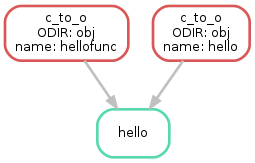
可以看出,shell调用变得更具可读性,例如 "{CC} -c -o {output} {input} {CFLAGS}" 而不是 $(CC) -c -o $@ $< $(CFLAGS) 。 此外,当不再需要 ``.o``文件时,Snakemake会自动删除它们,因为它们被标记为临时文件。
使用LaTeX构建文档
Snakemake也可以自动生成科学论文。 除了编译LaTeX代码和调用BibTeX,我们还提供了一条特殊规则来压缩所需文件以进行在线提交。
我们首先提供一个Snakefile tex.rules,其中包含可以为任何latex构建任务时共享的规则:
ruleorder:  tex2pdf_with_bib > tex2pdf_without_bib

rule tex2pdf_with_bib:
    input:
        '{name}.tex',
        '{name}.bib'
    output:
        '{name}.pdf'
    shell:
        """
        pdflatex {wildcards.name}
        bibtex {wildcards.name}
        pdflatex {wildcards.name}
        pdflatex {wildcards.name}
        """

rule tex2pdf_without_bib:
    input:
        '{name}.tex'
    output:
        '{name}.pdf'
    shell:
        """
        pdflatex {wildcards.name}
        pdflatex {wildcards.name}
        """

rule texclean:
    shell:
        "rm -f  *.log *.aux *.bbl *.blg *.synctex.gz"
注意如何区分带有和不带有相同名称的 .bib 的 .tex 文件。假设 paper.tex 和 paper.bib 都存在,则产生了歧义:原则上,这两个规则都是适用的。这将导致 AmbiguousRuleException ,但由于我们在文件中指定了明确的规则顺序,因此在这种情况下,首选 tex2pdf_with_bib 规则。如果 paper.bib 文件不存在,则该规则不再适用,唯一的选择是执行规则 tex2pdf_without_bib 。
假设上述文件另存为 tex.rules,然后从包含以下常见规则的特定Snakefile构建实际文档:
DOCUMENTS = ['document', 'response-to-editor']
TEXS = [doc+".tex" for doc in DOCUMENTS]
PDFS = [doc+".pdf" for doc in DOCUMENTS]
FIGURES = ['fig1.pdf']

include:
    'tex.smrules'

rule all:
    input:
        PDFS

rule zipit:
    output:
        'upload.zip'
    input:
        TEXS, FIGURES, PDFS
    shell:
        'zip -T {output} {input}'

rule pdfclean:
    shell:
        "rm -f  {PDFS}"
用户可以执行4个不同的任务。 构建全部PDF:
$ snakemake
Create a zip-file for online submissions:
$ snakemake zipit
清理所有PDF:
$ snakemake pdfclean
清理Latex临时文件:
$ snakemake texclean
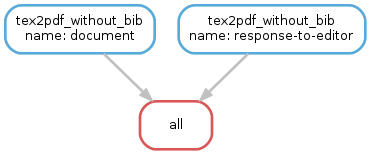
以下DAG任务将在完整运行时执行: